
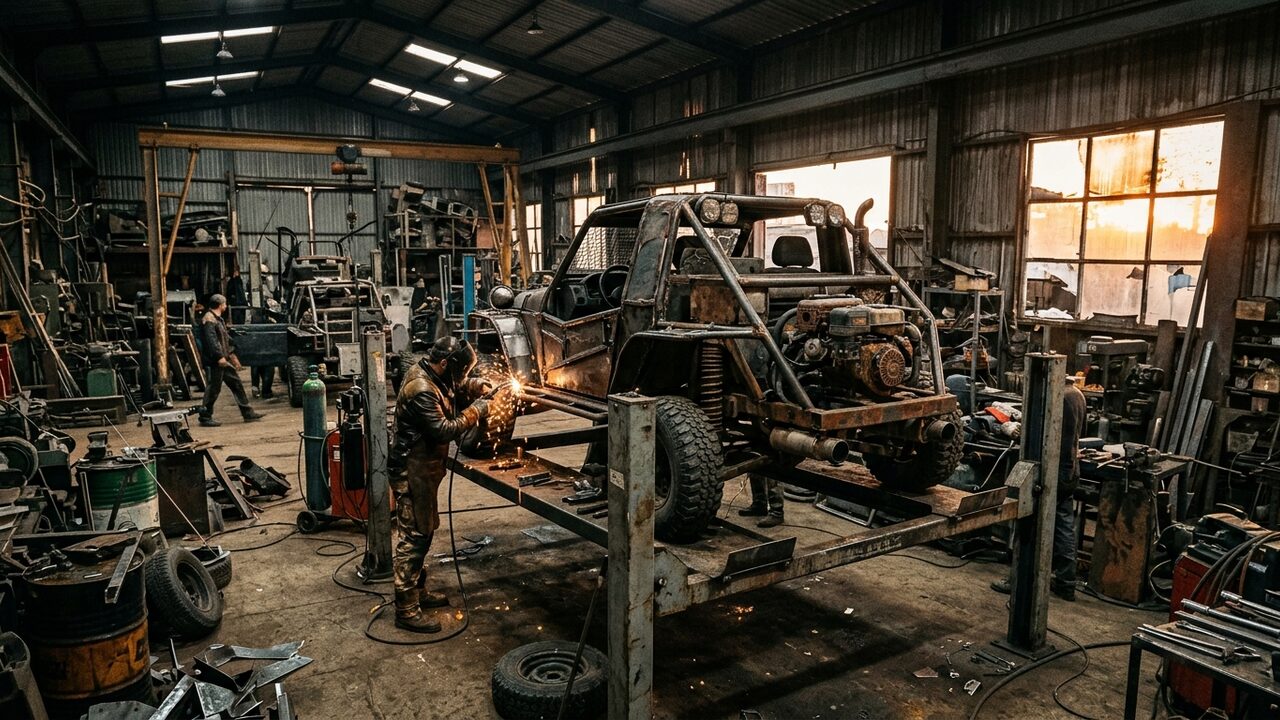
In Targem Games and Gaijin Entertainment's post-apocalyptic vehicular crafting combat simulator Crossout, the garage is just as lethal a battleground as the radioactive wasteland itself. Unlike traditional arcade vehicular shooters with rigid pre-defined class presets, Crossout gives engineers complete anatomical freedom to weld together chassis frames, cabins, internal combustion generators, hardware coolers, weapon mounts, and structural armor plating from hundreds of individual components.
However, freedom without mathematical discipline is a death sentence in the wasteland. Every single part welded to your armored rig contributes to a global metric known as Power Score (PS). Power Score is the matchmaker's absolute law: it dictates the tier of opponents you face in competitive PvP missions.
Following the seismic 2026 Energy and Tonnage Overhaul Balance Update, the fundamental mathematical rules of Crossout engineering were rewritten:
- The base Energy System was completely recalibrated (doubling nominal energy points from a 16-point scale to a granular 32-to-40 point scale) to allow precise balance tuning of hardware modules, radiators, and weapon costs.
- Cabin Tonnage and Mass Limit curves were tightened, making overloading your wheels or tracks devastating to vehicle acceleration, top speed, and turning radius.
- Structural armor parts received rebalanced durability-to-mass and durability-to-PS ratios, severely punishing inefficient "brick builds" while elevating high-efficiency spaced armor engineering.
In the cutthroat low-to-mid Power Score brackets—specifically 2,499 PS, 3,499 PS, and 4,699 PS—engineering mistakes are mercilessly exposed. Novice builders frequently bloat their vehicles with unnecessary armor or oversized generators, propelling their fragile buggies into lobbies populated by min-maxed veteran smurfs armed with stripped weapon configurations.
At Game Vault Forum, founded by Joel Ayuba (LinkedIn Profile | Company Page), our Wasteland Combat Engineering Desk spent hundreds of hours in the test drive arena and Clan Wars scrims analyzing the 2026 balance changes. This masterclass blueprint breaks down the exact physics of Power Score, Energy budgets, and Tonnage efficiency, revealing how to build virtually indestructible, high-lethality combat vehicles in low-PS lobbies.
Title: Crossout 2026 Engineering Balance Matrix
Badge: Wasteland Blueprints
- The Granular Energy Rule: The 2026 balance update doubled energy values (e.g., standard cabins provide 20 to 24 energy instead of 10 to 12), allowing low-PS hardware like coolers and radars to cost 1 or 2 energy rather than disproportionately punishing light builds.
- The Tonnage vs. Mass Law: Exceeding Tonnage instantly cuts top speed and acceleration by up to 50%; exceeding Mass Limit prevents the vehicle from entering combat entirely. Movement parts must provide at least 15% surplus tonnage over cabin weight.
- 90% Pass-Through Grille Mounting: Weapons and high-value hardware must NEVER be welded to standard cabin armor; they must be mounted on shoot-through parts (Buggy Floors, Gun Mounts) anchored directly to multiple heavy chassis frames.
- The Generator Trap: Carrying an epic or legendary generator in a 3,500 PS lobby turns your vehicle into a rolling bomb for negligible firepower gains. Stick to low-PS light generators (Ampere or Charge) placed in recessed frame cavities.
---
1. The Power Score Physics: Why Low-PS Matches Are Won in the Garage
To dominate low-PS lobbies, you must understand how the matchmaker groups players:
```
CROSSOUT MATCHMAKING BRACKET ARCHITECTURE:
- Bracket 1 (Beginner Scrim): 0 to 2,499 PS (Common/Rare parts, pure speed & brawling)
- Bracket 2 (The Sweet Spot): 2,500 to 3,499 PS (Optimized Special/Teal weapons, light cabins)
- Bracket 3 (Mid-Tier Combat): 3,500 to 4,699 PS (Calculated Epic modules, spaced armor)
- High-Tier Chaos: 6,000 to 9,000+ PS (Heavy armor bricks, Relic weapons, hover meta)
```
In the 2,499 PS and 3,499 PS brackets, health pools are relatively small, and matches are fast, aggressive, and brutal. A single shotgun blast or accurate autocannon burst can strip an exposed weapon in seconds.
The most fatal mistake made by novice builders is Power Score Inflation:
- A player mounts heavy, cool-looking structural plates from the Scavengers or Steppenwolfs faction.
- These plates add 400 PS and 1,200 kg of weight, but provide minimal explosive resistance.
- The bloated PS pushes the player out of the 2,499 bracket into a 3,500 lobby.
- In that higher lobby, enemy vehicles are armed with high-tier weapons that slice through the heavy armor in two seconds flat, while the bloated vehicle is too slow to escape.
The Golden Engineering Law of Low-PS: Every single point of Power Score on your vehicle must contribute directly to either lethal firepower, high mobility, or protecting your explosive heart.
---
2. The 2026 Energy System Overhaul: Granular Power Budgets
Prior to the 2026 balance patch, Crossout used a coarse 1-point energy scale:
- Common cabins had 8–9 energy
- Rare cabins had 10–11 energy
- Special cabins had 11–12 energy
Because weapons cost 3 or 4 energy, equipping a utility hardware module (like a car jack, light radiator, or radio) required dedicating 1 full energy point—an enormous 10% penalty to your total power pool. Developers could not finely tune weak items without making them overpowered.
The 2026 Multiplier Overhaul
In 2026, Targem doubled base energy across all cabins, weapons, and hardware:
- Light Rare Cabins (Growl): 22 Energy Points (formerly 11)
- Medium Rare Cabins (Wyvern): 20 Energy Points (formerly 10)
- Light Generators (Ampere): +4 Energy Points (formerly +2)
- Heavy Generators (Gasgen): +6 Energy Points (formerly +3)
Why This Revolutionized Low-PS Builds:
With doubled values, developers introduced fractional hardware costs:
- Specialized light radiators now cost only 1 energy point (equivalent to 0.5 energy in legacy math), allowing low-PS brawlers to sustain weapon fire without sacrificing weapon slots!
- Weapons were re-tuned: lightweight shotguns (Mace, Sledgehammer) consume 6 energy points each, allowing a Growl cabin (22 energy) with a small generator (4 energy) to run four shotguns simultaneously (24 energy total) with 2 energy remaining for cooling hardware!
---
3. Tonnage vs. Mass Limit: The Mechanical Difference
Understanding your vehicle's physical weight distribution is critical to handling and survivability:
```
TONNAGE VS. MASS LIMIT MATHEMATICAL DEFINITIONS:
1. Dry Cabin Weight: The base weight of the cabin itself.
2. Tonnage: The total weight your movement parts (wheels, tracks, hovers) can dynamically support.
Total Tonnage = Cabin Base Tonnage + Sum of All Wheel Tonnages
3. Mass Limit: The absolute structural capacity of the vehicle's engine and chassis.
Total Mass Limit = Cabin Mass Limit + Engine Bonus
```
The Tonnage Redline Penalty
If your vehicle's total weight exceeds its Tonnage (even by 1 kilogram), the vehicle enters Tonnage Overload:
- Top speed is instantly reduced by up to 50%.
- Acceleration collapses: your wheels spin out, taking 8 seconds to reach 40 km/h.
- Turning radius doubles, making shotgun circling impossible.
- In combat, an overloaded vehicle is an immobile target that can be easily outflanked and stripped.
The Optimal Low-PS Rule:
Always maintain a Tonnage Safety Buffer of at least 12% to 18%. In the heat of battle, losing a single wheel to enemy gunfire strips that wheel's tonnage contribution from your vehicle. If your build was redlining on tonnage, losing one wheel instantly plunges your remaining chassis into catastrophic overload, immobilizing you. A healthy tonnage buffer allows your buggy to maintain full speed and retreat even after losing an outer tire!
---
4. Structural Engineering: Frame Pass-Through Grille Welds
Where and how you attach your parts is ten times more important than what parts you use.
The 90% Pass-Through Rule (Shoot-Through Grilles)
In Crossout, certain structural parts have the special property: "Lets 90% of damage through". These include:
- Buggy Floors
- Gun Mounts
- Small and Medium Struts
- Pipe Pieces
When an enemy bullet or cannon shell strikes a Buggy Floor, 90% of the projectile's damage passes harmlessly through the piece without inflicting structural damage, while only 10% of the damage is absorbed!
Furthermore, these pass-through grilles possess massive attachment welding points. Never mount weapons directly to your cabin or standard armor plates. Standard armor plates fall off after taking 80 damage, instantly dropping any weapon attached to them. Instead:
1. Weld a Buggy Floor or Gun Mount directly to your heavy structural steel frames.
2. Mount your weapons (shotguns, machine guns, autocannons) directly onto the pass-through grille.
3. Because the grille has high pass-through resistance and is anchored directly to the indestructible chassis frames, enemies cannot shoot off your guns without destroying the entire frame!
---
5. Spaced Armor Physics: Dissipating the High-Explosive Blast Sphere
Cannons (Little Boy 6LB, Judge 76mm) and rocket launchers (Wasp, Pyralid) deal two distinct types of damage:
1. Bullet Impact Damage: Hits the first surface.
2. Explosive Blast Sphere: Expands outward in a 3D spherical radius from the point of impact, dealing full damage to every single component caught inside the sphere.
title: Ballistic Armor Architecture: Solid Brick Stacking vs Spaced Screen Defense
badge: Wasteland Physics
- Solid Brick Stacking (Fatal Error): Welding armor plates directly flush against your cabin allows 3D explosive blast spheres from cannons and rockets to propagate straight through the solid geometry, instantly detonating your generator and stripping wheels.
- Spaced Armor Screens (Engineering Mastery): Welding lightweight sacrificial plates 4 to 6 pins outward on structural outriggers forces high-explosive ordnance to detonate in empty air, completely dissipating blast radius energy before it reaches vital modules.
| Armor Configuration | Stand-Off Air Gap | Impact Point Mechanics | Blast Sphere Propagation | Cabin & Generator Survival Rate | Mass-to-HP Efficiency |
| :--- | :--- | :--- | :--- | :--- | :--- |
| Solid Brick Stacking | 0 Pins (Flush) | Hits outer sheet metal | Penetrates 100% into cabin & generator | 0% (Instant Detonation) | Extremely Poor (Heavy & Vulnerable) |
| Single Spaced Layer | 2 to 3 Pins | Detonates on outer screen | Partial blast splash touches chassis | 45% (Surface Damage) | Good |
| Full Stand-Off Screen | 4 to 6 Pins | Detonates on sacrificial bumper | Dissipates 100% in empty air gap | 98% (Zero Internal Damage) | Maximum (Optimal Low-PS Meta) |
| Pass-Through Grilles | 3 to 5 Pins | 90% bullet damage bypass | Only absorbs 10% damage, protects mount | 92% (High-Durability Gun Mount)| Elite for Machine Gun Hardpoints |
title: Wasteland Engineering Rule: Weld Points & Pass-Through Parts
badge: Structural Integrity
- Grille & Buggy Floor Synergy: Shoot-through parts let 90% of ballistic fire pass through harmlessly while possessing immense weld-point durability.
- Hardpoint Discipline: Always mount your primary guns (Sledgehammers, Sinus, Storms) directly onto Buggy Floors or Gun Mounts, never onto cosmetic sheet metal armor. If the decorative armor plate falls off, an unanchored gun falls off with it!
By welding lightweight sheet-metal armor (such as Cultist or Lunatic bumper parts) 4 to 6 pins outward from your cabin on extended frame outriggers, you create a sacrificial spaced armor shield. When an enemy cannon shell detonates against the outer plate, the explosive blast sphere expands entirely in the empty air gap, dealing zero damage to your cabin, wheels, or generator!
---
6. The Generator Trap: Why Big Generators Kill Low-PS Builds
Every generator in Crossout is a ticking time bomb. When a generator's durability reaches zero, it catastrophically detonates, dealing massive explosive damage to every component adjacent to it.
In 2,499 PS and 3,499 PS lobbies:
- Mounting an Epic Gasgen (+6 energy) adds 860 Power Score and has a pathetic 36 points of durability. One stray stray machine gun bullet detonates it, instantly ripping your vehicle in half from the inside out!
- The Pro Strategy: In low-PS lobbies, run a Rare Ampere or Common Charge Generator, or run no generator at all! The Growl cabin provides 22 energy natively—more than enough to power three potent weapons without carrying a volatile bomb under your seat.
- If you must carry a generator, mount it in an Under-Slung Frame Cradle: weld a recessed drop-box between two Heavy Frames directly underneath the rear axle, completely shielded by solid steel frames on all four sides.
---
7. Three Battle-Tested Low-PS Blueprint Schematics
Blueprint 1: The "Scrap Vulture" (2,499 PS Shotgun Wedge)
- Role: High-speed flanker and weapon-stripper.
- Cabin: Growl (Rare Light Cabin, 22 Energy).
- Movement: 4x Racing Wheels ST (Steering) + 2x Small Wheels (Non-Steering rear).
- Weapons: 3x Sledgehammer Shotguns (6 Energy each = 18 Energy).
- Hardware: 1x R-2 Chill Radiator (2 Energy) + 1x CS Taymyr Cooler (2 Energy). Total Energy: 22/22 (Zero generator needed!).
- Chassis: Low-slung wedge chassis angled downward using Small Wheels in front and Racing Wheels in rear. Bumper "Catchers" mounted on front to scoop under enemy chassis, lifting their wheels off the ground to eliminate their steering while you strip their weapons at point-blank range.
Blueprint 2: The "Sentry Hawk" (3,499 PS Dual-Autocannon Gun-Truck)
- Role: Long-range sniper and perimeter defense.
- Cabin: Wyvern (Rare Medium Cabin, 20 Energy) for superior mass limit and durability.
- Movement: 6x Medium Wheels ST (High redundancy against wheel loss).
- Weapons: 2x AC50 Storm Autocannons (10 Energy each = 20 Energy).
- Hardware: 1x Scope + 1x Radio (welded to cabin roof for maximum team radar coverage).
- Chassis: High-clearance truck frame with weapons mounted behind a recessed cabin cowl on Buggy Floors. Spaced armor screens mounted on sides to absorb flanking rocket volleys.
Blueprint 3: The "Sand Viper" (4,699 PS High-Speed Machine Gun Brawler)
- Role: Mid-range skirmisher and cabin-melter.
- Cabin: Growl (22 Energy) + Ampere Generator (+4 Energy) = 26 Energy Total.
- Movement: 4x Shiv Wheels ST (High ramming melee damage resistance).
- Weapons: 3x Sinus-0 (Special Machine Guns, 8 Energy each = 24 Energy).
- Hardware: 1x Seal Radiator (2 Energy).
- Chassis: Highly agile sports-car silhouette with spaced bumper outriggers. Weapons top-mounted in staggered echelon configuration, allowing all three machine guns to fire forward simultaneously over the roofline.
---
8. Wasteland Combat Engineering Reference Table
| Vehicle Component | Low-PS Recommendation | Optimal Weld Point | Fatal Mistake to Avoid |
| :--- | :--- | :--- | :--- |
| Cabin | Growl (Light, 22 Energy) or Wyvern | Central chassis placement | Heavy, slow truck cabins in sub-3k PS |
| Movement | Racing Wheels ST / Shiv Wheels | Direct weld to Heavy Frames | Overloading tonnage with heavy armored tracks |
| Weapons | Sledgehammer (SG), Storm (AC), Sinus | Buggy Floors / Gun Mounts ONLY | Mounting directly onto standard armor plates |
| Generator | Ampere (+4 Energy) or No Generator | Under-slung frame recessed cradle | Carrying exposed Gasgen generators on vehicle roof |
| Cooling Hardware| R-2 Chill / Shiver Radiator | Tucked behind cabin bulkhead | Placing coolers outside structural armor |
| Front Bumper | "Catch" or "Terribar" Bumpers | Anchored to front frame tips | Using cosmetic plastic grilles for ramming |
For companion vehicular combat guides, calculate system benchmarks in our FPS Calculator, check hardware limits in our PC Game Requirements Checker, and discuss battle-tested blueprints in the Game Vault Community Forum.