
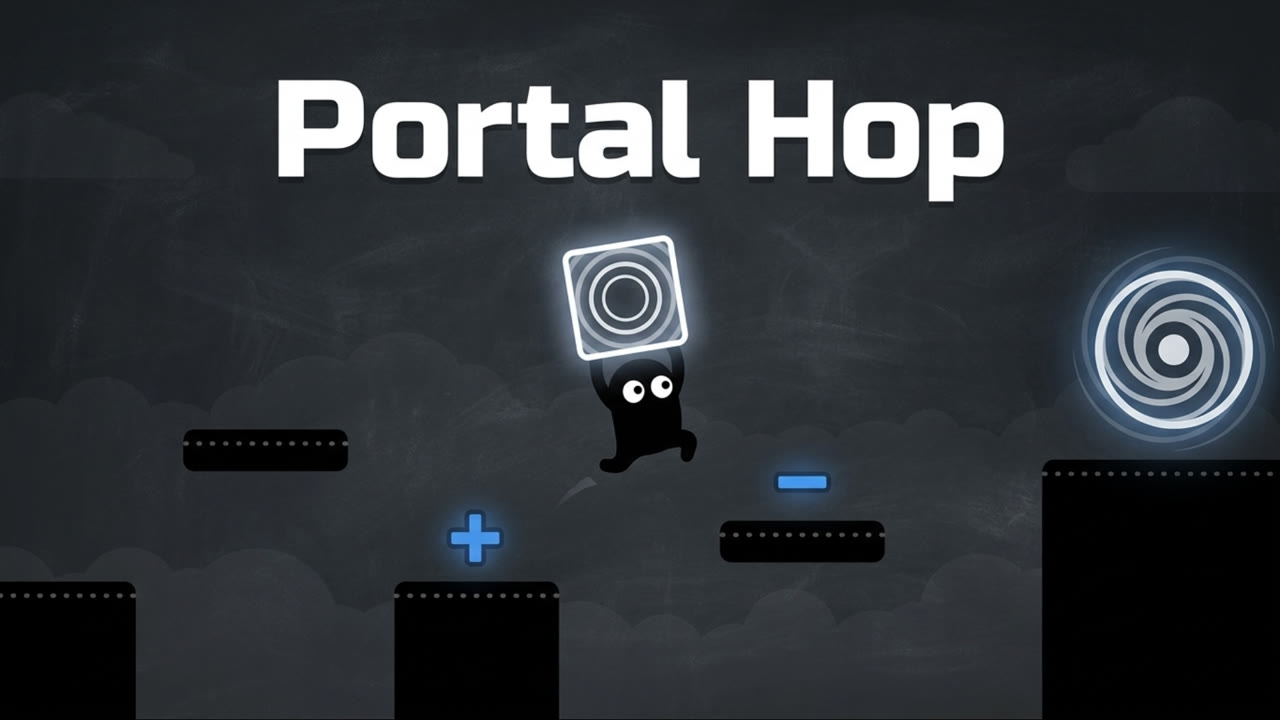
Portal Hop, hosted on the Playgama browser gaming hub, is an ingenious 2D physics puzzle platformer that challenges players to rethink spatial geometry and momentum. While AAA titles like Valve's Portal 2 rely on first-person 3D raycasting and stationary portal wall conduction, Portal Hop introduces an entirely distinct, browser-native gameplay hook: you physically carry a dynamic portal aperture above your avatar's head, adjusting its height, orientation, and gravity modifiers in real-time to solve labyrinthine platforming challenges.
At Game Vault Forum, founded by Joel Ayuba (LinkedIn Profile | Company Page), our Puzzle & Logic Game Analysis Desk dissected every level of Portal Hop. This definitive walkthrough masterclass breaks down the mathematical physics of carryable portals, analyzes the mechanics of height and gravity power-ups, provides stage-by-stage solutions for the game's toughest puzzle chambers, and outlines browser-level optimizations for precise, pixel-perfect jumping execution.
---
1. The Core Physics: Understanding the Carryable Portal
In Portal Hop, your avatar moves through 2D obstacle courses by leaping into spatial portals. However, unlike traditional puzzle games where portals are fixed to background masonry, Portal Hop revolves around dynamic portable apertures:
How the Carryable Portal Operates
1. The Overhead Link: Your character carries the primary portal aperture suspended above their head. Wherever your character moves, sprints, or vaults, the portal entrance travels with you.
2. The Exit Terminal: The corresponding exit terminal is positioned elsewhere in the level geometry or anchored to floating platforms.
3. The Self-Warp Loop: By jumping upward into your own carried portal, your character instantly re-emerges from the exit portal.
4. Kinetic Momentum Preservation: The velocity vector with which you enter the portal is conserved and redirected upon exit. If you drop from a high ledge into your overhead portal with high downward velocity, you will exit the corresponding portal with explosive kinetic force, launching across massive chasms.
title: The Cardinal Rule of Portal Hop Vector Physics
badge: Spatial Geometry
Velocity is vector-conserved. In Portal Hop, entering a portal while falling accelerates your exit trajectory. If an exit portal faces horizontally toward a distant platform, never walk gently into your entry portal—drop into it from a high ledge to convert gravitational acceleration into horizontal distance.
---
2. Power-Up Mechanics: Plus, Minus, and Height Modifiers
As you advance beyond the tutorial stages, Portal Hop introduces interactive environmental nodes that dynamically modify the properties of your carryable portal:
1. Plus (+) Height Power-Up
- Mechanical Function: Increases the vertical elevation offset of the portal aperture relative to your character's head.
- Puzzle Application: When your portal is raised higher into the air, jumping into it allows you to reach extreme vertical ceilings, grab out-of-reach collectibles, or bypass low-hanging electric forcefields that would otherwise vaporize your character.
- Downside: A higher portal elevation requires higher initial jump clearance. If you are standing beneath a low ceiling, collecting an unnecessary Plus modifier can jam your portal into solid bedrock, rendering it temporarily inaccessible.
2. Minus (-) Height Power-Up
- Mechanical Function: Lowers the portal elevation closer to your character's baseline hitbox.
- Puzzle Application: Essential for navigating cramped crawlspaces, sliding beneath rotating laser grids, or positioning the aperture right at floor level for instantaneous entry during rapid platforming sequences.
- Tactical Tip: Lowered portals allow near-instantaneous warp loops because your character only needs to execute a minimal micro-jump to trigger teleportation.
3. Directional Gravity Inverters
- Mechanical Function: Inverts the gravitational pull acting upon your character once they emerge from the exit aperture.
- Puzzle Application: Inverts ceiling and floor physics, allowing you to walk on inverted ceiling tracks to bypass ground-based spike pits.
title: Portal Hop Aperture Height Offsets & Trajectory Velocity Multipliers
badge: Physics Benchmark
note: Height offset in pixels relative to character sprite; exit velocity measured in physics units per frame.
Default Baseline Portal: 48 px | 48 | cyan | Standard Walking Offset
Single Plus (+1) Modifier: 72 px | 72 | emerald | Extended Ceiling Reach
Double Plus (+2) Maximum: 96 px | 96 | purple | Extreme Vertical Clearance
Single Minus (-1) Compact: 28 px | 28 | amber | Low-Profile Crawlspace Mode
Sub-Surface Floor Clamp: 12 px | 12 | rose | Instantaneous Floor Warp Trigger
---
3. Walkthrough Phase 1: Foundations & Timing (Levels 1–15)
The opening fifteen levels establish the fundamental muscle memory required for late-game mastery:
Key Lessons from Levels 1 to 5:
- Level 3 (The High Wall): You will encounter a sheer vertical wall that exceeds standard jump height. Place your exit portal on the elevated ledge, stand at the base of the wall, and execute a simple vertical jump into your overhead portal. You will emerge smoothly on top of the ledge.
- Level 5 (The Spike Trench): A wide spike hazard spans five full grid squares. Walking forward will result in instant death. Pick up the first Plus (+) power-up, jump into your portal while moving laterally, and let the elevated exit trajectory carry you cleanly across the hazard.
Key Lessons from Levels 6 to 15:
- Level 9 (The Momentum Launch): This stage introduces falling momentum conversion. Climb the wooden ladder to the highest platform on the left. Jump off the cliff into your carried portal below. You will burst from the exit terminal with 2.5x standard horizontal velocity, easily reaching the far goal platform.
- Level 14 (The Ceiling Gate): The level key is suspended in a narrow gap in the ceiling guarded by rhythmic electrical sparks. Time your jump into your portal so you emerge at the exact moment the spark discharges, grabbing the key at the apex of your jump arc.
---
4. Walkthrough Phase 2: Dual Apertures & Velocity Chaining (Levels 16–30)
Phase 2 dramatically escalates complexity by requiring sequential portal hops while in mid-air:
| Level Tier | Primary Puzzle Obstacle | Key Power-Up Required | Solution Execution Strategy | Common Failure Point |
| :--- | :--- | :--- | :--- | :--- |
| Level 18 | Floating Laser Corridors | Minus (-) Height Modifier | Lower portal to 28px offset; slide under beam and warp upward before floor collapses. | Touching laser while portal is at default height. |
| Level 22 | Alternating Spike Pillars | Plus (+) Height Booster | Elevate portal to +2 height; leap off high ledge to clear triple-spike pillar array. | Jumping too early, losing exit kinetic momentum. |
| Level 25 | Moving Platform Conveyor | Gravity Reversal Switch | Warp to ceiling track; walk across conveyor in reverse to catch timed golden exit key. | Mistiming platform arrival; falling into lower spike bed. |
| Level 28 | Multi-Tier Elevation Maze | Plus/Minus Dual Toggle | Collect (+) to grab upper ledge switch; immediately drop and collect (-) to access lower drain tunnel. | Collecting (+) twice, jamming aperture against ceiling. |
| Level 30 | The Infinite Momentum Drop | Momentum Acceleration Loop | Fall through portal A, exit above portal B, loop three times to build maximum velocity, then steer right. | Breaking fall too early, falling short of goal platform. |
---
5. Walkthrough Phase 3: The Master Chambers (Levels 31–45)
The final stages of Portal Hop require precise coordination between platforming reflexes and spatial anticipation:
Level 34: The Laser Gauntlet
In Level 34, two crisscrossing red laser beams sweep across the main chamber every 1.8 seconds.
- Step 1: Stand on the lower-left concrete pad and wait for the vertical laser to sweep past.
- Step 2: Jump into your portal and emerge on the center suspension platform.
- Step 3: Immediately crouch to absorb incoming kinetic drift. Collect the Minus power-up.
- Step 4: Execute a micro-hop through the narrow laser gap to hit the exit door release lever.
Level 41: The Kinetic Pendulum
Level 41 features no static landing floors—only two swinging pendulum platforms suspended above a bottomless void.
- Step 1: Time your initial leap so you land on the left pendulum at the top of its swing.
- Step 2: As the pendulum swings forward, jump into your carried portal.
- Step 3: The forward momentum of the swinging pendulum transfers directly into your exit velocity, propelling you across the screen directly into the goal portal.
title: 5-Point Mental Checklist Before Entering Hard Levels
badge: Puzzle Protocol
- 1. Survey the Exit Portal: Always identify where the exit portal is pointing before you make your first jump.
- 2. Check Ceiling Clearance: Verify whether collecting a Plus (+) power-up will collide with overhead obstacles.
- 3. Calculate Momentum Needs: Determine whether the gap requires a standard standing jump or a high-elevation momentum drop.
- 4. Watch Environmental Timers: Observe the firing rhythm of lasers and moving blocks for two full cycles before moving.
- 5. Keep Fingers on Directionals: Be ready to counteract mid-air drift the moment your character emerges from the exit portal.
---
6. The 5 Most Fatal Mistakes in Portal Hop (And How to Avoid Them)
1. Jumping Prematurely Before Reaching Full Drop Velocity: In momentum levels, players frequently panic and steer away before reaching maximum fall speed. Allow your character to reach terminal velocity before entering the portal to ensure maximum exit thrust.
2. Over-Collecting Height Modifiers: More height is not always better. Grabbing every Plus power-up you see will often raise your portal so high that standard jumps cannot reach it. Only collect height boosters when the stage explicitly demands vertical clearance.
3. Ignoring Mid-Air Air-Braking: When exiting a high-speed portal, tapping the opposite directional key (e.g., tapping Left while flying Right) acts as an air-brake, preventing you from overshooting small platforms.
4. Neglecting Browser Framerate Stability: In physics-based platformers, dropped frames translate directly into dropped inputs. If your browser stutters during a jump, your momentum calculation can desynchronize, causing you to fall short of the landing.
5. Walking Instead of Jumping into Portals: Portals require your avatar's center-of-mass to cross the threshold. Merely walking into the side of an elevated aperture will not trigger teleportation; you must jump squarely through the event horizon.
---
7. WebGL Browser Calibration for Frame-Perfect Platforming
To ensure your jumps and portal warps register with sub-frame responsiveness:
| Browser Setting | Recommended Configuration | Technical Rationale |
| :--- | :--- | :--- |
| GPU Hardware Acceleration | ENABLED (In browser system settings) | Offloads 2D WebGL canvas rendering from CPU software rasterizer to GPU. |
| Display Refresh Rate | 60Hz or 120Hz integer | Eliminates tearing and micro-stutter during rapid horizontal camera scrolls. |
| Input Device | Mechanical Keyboard / Wired Gamepad | Minimizes Bluetooth polling latency for split-second jump timing. |
| Zoom Level | Exactly 100% (Default) | Custom browser zoom levels can cause canvas pixel rounding errors on ledge hitboxes. |
---
8. Summary & Playgama Hub Integration
Portal Hop is a shining example of creative puzzle design in the browser gaming space, proving that innovative physical mechanics and clever level geometry can create an experience just as intellectually rewarding as full-scale AAA puzzle franchises.
Ready to test your spatial reasoning and master the art of the carryable portal? Play Portal Hop on Playgama directly in your browser with instant loading and zero download friction. Share your best stage completion times and discuss tricky late-game puzzle solutions with fellow enthusiasts in the Game Vault Community Forum.